
Sumerian Shakespeare
An Unknown Akkadian Queen
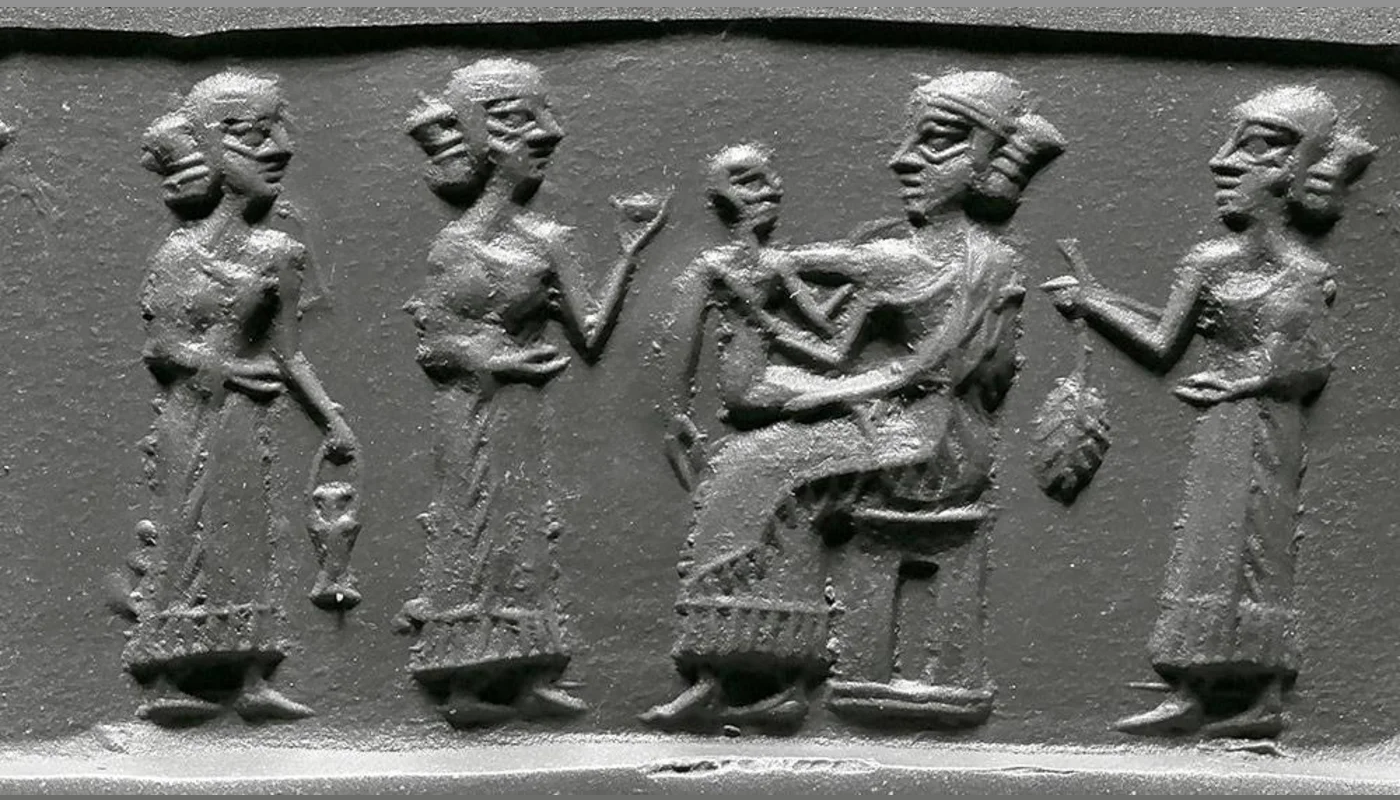
These notes are from The Morgan Library & Museum:
This carnelian seal features an exceptional depiction of a mother and child. A similar
motif of a goddess with a child in her lap is seen in other Akkadian cylinder seals,
but this woman is not divine: her coiffure and fringed dress match those of the three
mortal women in the scene. These women, attendants, look toward the seated pair
and present offerings of fronds and vessels. The mother looks lovingly at her child, emphasizing her role as caretaker; the little one gazes back at her adoringly.
Cylinder seal (and modern impression) with mother and child attended by women
Mesopotamia, Akkadian, Ur (modern Tell el-Muqayyar),
PG 871
Akkadian period (ca. 2334–2154 BC)
Carnelian and gold
University of Pennsylvania Museum of Archaeology and Anthropology, Philadelphia, USA, Excavated 1928; B16924
Courtesy of the Penn Museum
PG 871 is classified as a wealthy Private Grave, not one of the specific "royal tombs" with a large death pit and stone architecture.
* * * * * * * * * * * * * * * * * * * * * * * * * * * * * * * * * * * * * * * * * *
No one has ever mentioned it before, but the mother is an Akkadian queen.
The notes say that all the women have matching coiffures, but this isn’t exactly true.
More specifically, the “coiffures” are royal knotted buns, and there is a subtle difference between them.
The mother has three ribbons on her knotted bun, but the other women only have two.
It’s a subtle difference, but small differences are very meaningful in royal attire (like the difference between a two-star general and a three-star general).
I suggest that the mother is the queen and the other three women are princesses.
They are her ladies in waiting, or possibly her daughters.
Perhaps you noticed that the mother isn’t wearing a kaunakes that would prove she is a
royal queen. A kaunakes is a garment of woolen petals that was worn by Sumerian and Akkadian royals during ceremonial occasions. The kaunakes would show she is not merely
a titled noblewoman, but a member of the royal family, the ones who ruled the kingdom.
In other words, it would prove she is a reigning queen.
Bear in mind, however, that the kaunakes wasn’t worn every day. It was only worn during ceremonial occasions.
In addition, all of the women wear the same fringed dresses.
So how can we be sure that the mother is indeed a queen?
A big hint is given on the seal:

This woman is not offering a frond to the mother. She is holding the mother’s frond
(i.e., date cluster) because the mother has her hands full (literally).
The date cluster proves beyond a shadow of a doubt that the mother is a queen.

Inanna, the goddess of war, holding a date cluster. She was the “The Queen of Heaven”
who granted royal power to mortal men and women. The date cluster symbolizes their
divine to rule. Only kings and queens could carry a date cluster. Mere lords and ladies
were not allowed to use it.
This is explained in greater detail on the page about The Divine Right to Rule. There
you will see many kings and queens holding date clusters. They were deified monarchs
who were treated like living gods.
I considered the possibility that the date cluster and the vessels were intended for the child, presumably a boy, and the scene portrays a kind of baptism where the young prince
is anointed with the divine right to rule. However, I quickly discounted this possibility
because: 1) he is too young to be a reigning monarch, even if in name only, and
2) if this were an official ceremony, I would expect to see some priests involved. I doubt
that the ritual was performed in the privacy of the women’s quarters. In any case,
it would still mean that the mother is a royal queen,
As previously mentioned, the cylinder seal was found in PG 871, a wealthy Private Grave
in the Tombs of Ur. Although wealthy, it was not rich enough to be considered a queen’s grave. Instead the grave belonged to one of the ladies shown on the seal, perhaps the one who holds the date cluster. Cylinder seals were used for personal identification at a time in history
when most people didn’t know how to write their name. The seals were usually buried
with the person after their death.
This seal is important for a number of different reasons:
First, you never see a queen with a child on her lap, in a scene of domestic bliss. That is why
no one ever suspected she was a queen, but just a loving mother.
Second, it emphasizes the fact that there were lots of Akkadian royals (male and female alike)
in Ur during the 150 years of Akkadian occupation. There are three generations of Akkadians
in this one picture. They seem comfortably ensconced in their new homeland.
This leads us to the third reason. 150 years is a very long time to occupy a foreign country.
Did the Akkadians consider themselves to be strangers in a strange land, or did they think
that Sumer was their new homeland? When the princess was buried with her seal in the
tombs of Ur, did her friends lament that she died in a foreign country? Or did they think
she was laid to rest at home?
Meanwhile, the Sumerians were just biding their time. They will eventually overthrow
the Akkadians, and then occupy the Akkadian homeland in return.
Such is life, such is war, in ancient Mesopotamia.
January 10, 2026
