
Sumerian Shakespeare
Enheduanna
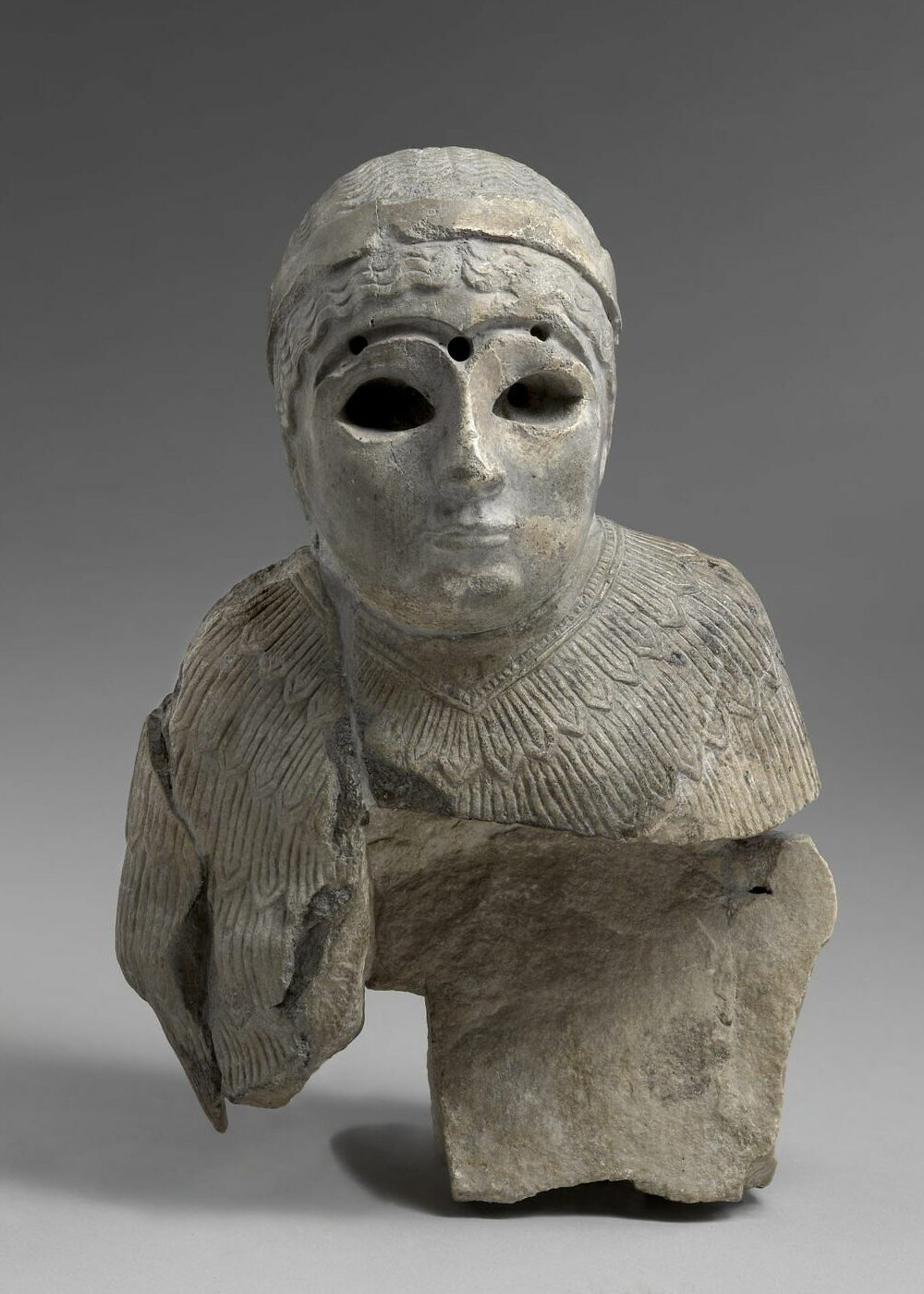
This votive statue was originally placed in a temple. It now resides
in the Louvre Museum (AO 4754).
(Click on any image. If an enlargement is available it will display in a separate tab)
Here are the notes from the Louvre website:
Bust of a seated orant [female worshiper], dressed in a kaunakès cloak, hair styled in a bun and held by a headband, the eyes and eyebrows were formerly inlaid.
Height: 22 cm [8.66 inches] Material: Limestone
Date: Akkadian (2350-2200 BC) and Neo-Sumerian (?) (c. 2112–2004 BC)
Place of discovery: Djokha = Umma (?) Acquisition date: 1911
In case you’re wondering...
There’s no way this statute dates to the Neo-Sumerian period (c. 2112–2004 BC).
Artistically speaking, it's unlike anything else in the Neo-Sumerian period, which was
the absolute end of Sumerian civilization. This statute clearly dates to the beginning of
the Old Akkadian Period.
In other words, it dates to the time of Sargon the Great and the beginning of the
Akkadian Empire.
The “?” after Umma, indicates that the provenance of the statue isn’t known for certain.
If the statue was indeed found in Umma (or any other Sumerian city) it means the statue
was placed in a temple after Sargon conquered the city. Conversely, the Sumerians
placed votive statues in the temples of the Akkadian cities that they conquered. Despite
their constant warfare, the Sumerians and the Akkadians practiced the same religion.
See The Standard of Mari.
I believe the statue is actually from the Sumerian city of Ur, for reasons that will soon
become obvious.

Profile views: Enlarge left, right.
This statue is important for a number of reasons:
First, a portrait of an Akkadian woman is exceedingly rare. When the Akkadian empire finally fell,
it was completely destroyed, and only a few of its artifacts remained.
Second, and most important, the woman is wearing a kaunakes, a garment of woolen petals
that was worn by Sumerian and Akkadian royals during ceremonial occasions. This means
she isn’t merely a titled noblewoman, she is a member of the royal family, the ones who ruled
the kingdom. In other words, she is either a royal princess or a reigning queen.
By extension, she is probably a high priestess, since royal women usually served in temples
(to keep the secular and religious power of the kingdom “all in the family”). The kaunakes was
most often used in temple settings. See Sumerian Queens.
Third, she wears her hair in a royal knotted bun with a simple headband.

The knotted bun was the hallmark of Akkadian royalty, male and female alike.

Notice that Sargon has the same kind of bun and headband. He is also wearing
a royal kaunakes. Detail of a religious procession where he celebrates his victory
over the Sumerians.
This leads us to a very interesting question:
Who is the woman portrayed on the statue?
She could be one of the many royal women who lived in the Akkadian empire, all of whom
we have never even heard about.
Maybe so, but I think she is much more important than that.
The surviving fragment, which only includes her body above the waist, is 8.66 inches tall.
This means the entire seated statue was more than 20 inches high. This is quite large
compared to most (if not all) votive statues, which were usually displayed on the altar.
She is obviously a very important woman, one of the most important women in all of Akkad.

By contrast, this complete statue of the Sumerian "Queen of Queens" is only 7.5 inches tall.
It seems highly probable that the statue in the Louvre is a female relative of Sargon – perhaps
his wife, mother, sister, or daughter.
It’s entirely possible that she is the wife of Sargon, so she may be the Akkadian version of the
Queen of Queens.
But there is another more intriguing possibility – that she is actually Enheduanna, the daughter
of Sargon.

In the modern world, Enheduanna is perhaps more famous than her father.
Enheduanna is the first author in world history that we know by name (Mesopotamian scribes did not sign their literary compositions). Very few people know about Sargon the Great,
but lots of people (mostly women) know about his illustrious daughter, Enheduanna.
There has been some academic debate on whether Enheduanna actually wrote all of the literature that has been ascribed to her. That’s because the earliest known Babylonian copies of her work are dated a few centuries after her death. Personally, I think it means something
that the very best Akkadian literature is credited to Enheduanna. She is noticeably better
than most Babylonian writers.
Ironically, Enheduanna is sometimes called "the Sumerian Shakespeare" (get it?) which is doubly ironic considering the fact that she was not a Sumerian.
Like all royal Akkadian women, Enheduanna was also a high priestess. Sargon assigned her
to the temple of Nanna, the moon god, in the Sumerian city of Ur. This was one of the most important cities that Sargon had conquered.

The Enheduanna disk. It shows the high priestess Enheduanna performing a
religious ceremony in the temple of Inanna, the goddess of war.
Enheduanna wears the flounced dress of a Sumerian priestess. Her hair is loose
and her headdress indicates that she is the high priestess of the temple.
The back of the disk includes a heavily damaged inscription that originally stated,
“Enheduana, zirru priestess (of Nanna), the wife of Nanna, daughter of Sargon,
king of the world, built an altar in the temple of Inanna-Zaza, at Ur, and named it
‘The Table of Heaven.’”
Sargon had a great affinity for the goddess of war. So did Enheduanna. Many of
her poems are dedicated to Inanna.
Inanna, wearing a flounced dress.

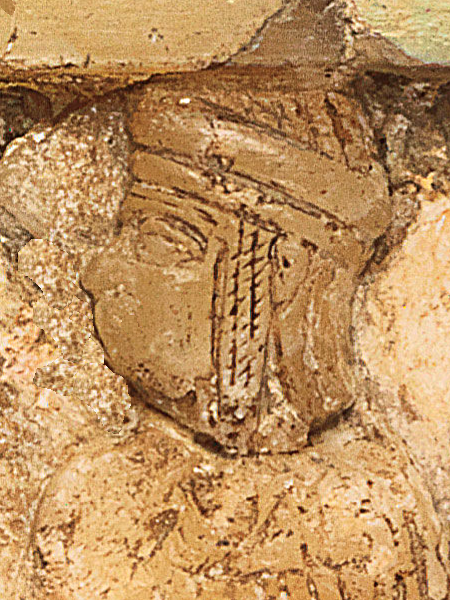
Profile view of Enheduanna. Enlarge.
During the preceding Early Dynastic period, human portraits were rather crude. The faces were generic, without any attempt to make them resemble the people they portrayed. Portraits became more natural and realistic during the Neo-Sumerian revival (like the
statues of Gudea and Ur-Namma, for instance) but until now there hasn’t been a known
realistic portrait of any person from Akkad.
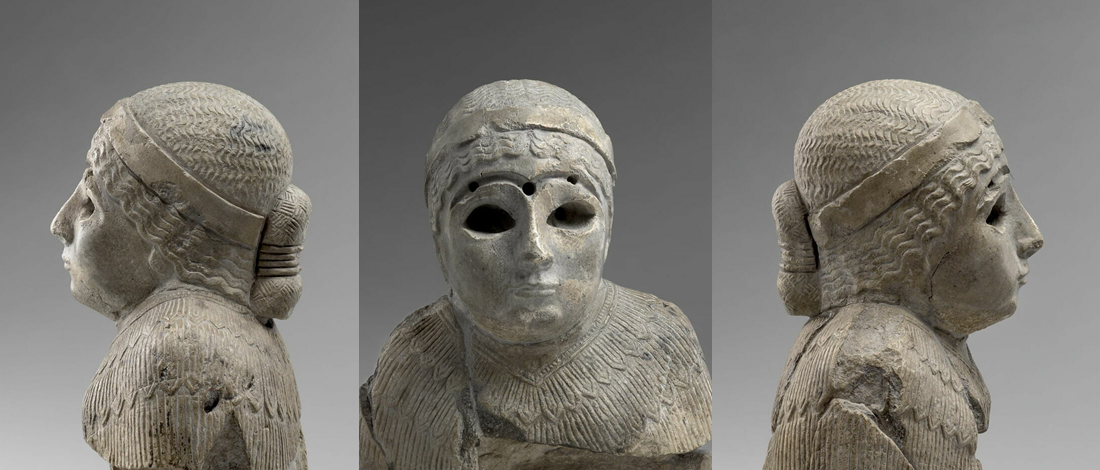
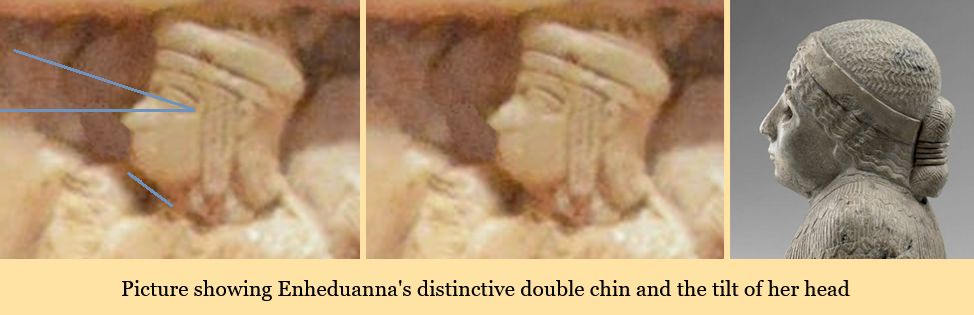
This is a realistic portrait of Enheduanna. Her profile (with her tilted head and double chin)
is done precisely. It very much resembles the profile of Enheduanna that is shown
on her disk. Websites that describe the disk often say Enheduanna is "gazing heavenward"
or "raising her eyes to Inanna," or something to that effect, but this statue shows it is just
her natural posture. Enheduanna's face, with the exception of the ubiquitous joined-eyebrows
of Mesopotamian statues, is also done realistically.
Looking at this picture is just like looking at Enheduanna, the woman herself.
This may not be the “glamor shot” of Enheduanna that many people might have hoped for,
but is shows us exactly how she looked in real life. You would recognize this woman
if she walked into the room.
The statute was obviously modeled from real life. Enheduanna is one of the few women
in the world who was important enough in her lifetime to warrant a large realistic portrait
carved in stone. See the 3/4 view of the statue.
Enheduanna has her own look going on. No one else looks like her.
Besides being the first author known by name, Enheduanna is the first recognizable woman
in all of human history.
Enheduanna was a princess, a poet, and a priestess. She is one of the most fascinating
women who ever lived.
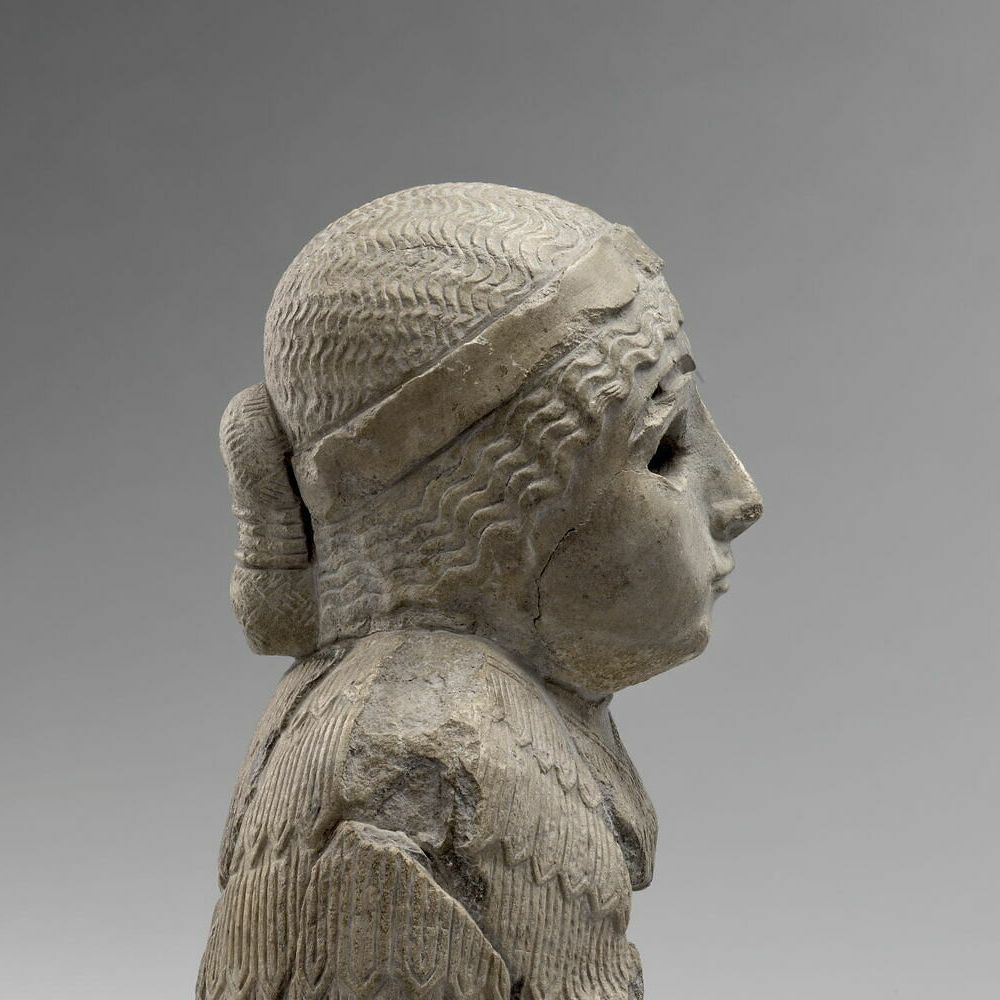
Enheduanna. This is one of the most important statues in the world today.
Unfortunately, the Louvre does not display Enheduanna with the proper respect.

Enheduanna: princess, zirru priestess, tablet writer (scribe).
In the modern era, learning how to read and write is relatively easy, but in ancient times,
it was incredibly difficult. A scribe had to study for many years to learn cuneiform writing.
It was the world’s most complex writing system. Professional scribes were less than
1% of the population, and very few of them were women.
Enheduanna did not need to read and write in order to become a priestess, because
at this time in history, even the kings and queens were illiterate. They simply used professional scribes.
Enheduanna was born a princess, and ordained a priestess. It was her royal destiny.
She could have easily coasted through life. But being an author was her own choice,
her own personal achievement. This was entirely the result of her diligent studies,
her keen intelligence, and her love of literature.
Enheduanna was an inspiration to women writers more than 4,000 years, and she
is still an inspiration for women writers today.
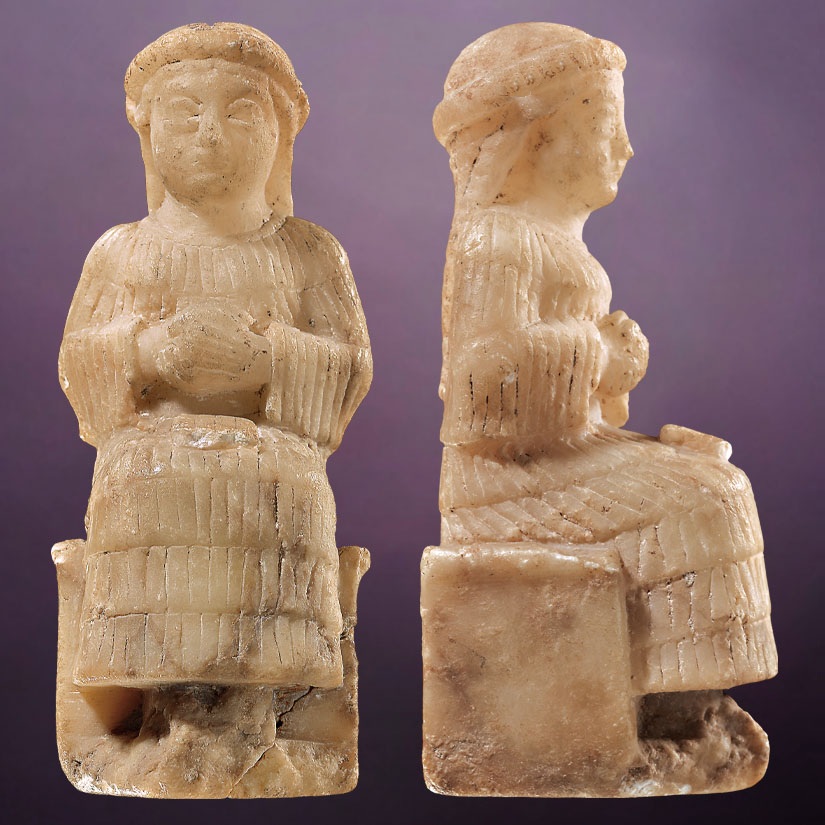
Votive statuette of a Sumerian high priestess. From the Ur III period, about 200-300 years
after Enheduanna.
The drapery of Enheduanna’s robe suggests that her hands were folded in prayer, like the priestess shown above. It was a common motif for votive statutes.
This priestess proudly displays a cuneiform tablet on her lap. I’m willing to bet that Enheduanna did the same thing on her statue.
On the other hand, most priestesses could not read or write. Only a few of them could decipher
the administration records for their own temple (receipts, ledgers, etc.). These bookkeeping tablets
were “easier” to read than literary tablets because they contained mostly nouns and numbers. Enheduanna was the only priestess who wrote original works of literature, which uses complex language to express complicated ideas. Even the professional scribes had difficulty doing this.
Enheduanna’s literary works were taught in Babylonian scribal schools for hundreds of years. There
is absolutely no evidence that the Babylonian scribes wrote any of the stories they attributed to Enheduanna. They merely copied the works of Enheduanna because she was so greatly admired.
After all, she was (and still is) the most famous scribe in the world.

As explained on a separate page, this mother is an unknown Akkadian queen.
The cylinder seal is from a rich grave in the Tombs of Ur. It is dated in the Akkadian period
(ca. 2334–2154 BC). When I first saw it, I thought, “Hmm... an Akkadian woman, in Ur,
at the time of the Akkadian occupation... I wonder if it is Enheduanna.”
Then I realized there is a slight problem with this assumption.
Enheduanna was a priestess, a celibate. She didn’t have any kids.
Nonetheless, this got me to thinking about Enheduanna in a whole different way:
Enheduanna’s personal life
Most people (myself included) tended to think of Enheduanna as a young woman, a princess.
We imagined her as a strong and independent “career woman” who busied herself with
the glamorous job of being a priestess and a royal aristocrat. We didn’t think of her as a wife,
a mother, or even a daughter (except for being descended from Sargon).
On the disk, Enheduanna calls herself “the wife of Nanna,” the moon god. I thought this
was merely a symbolic title, because most Mesopotamian priestesses were not celibate.
For example, Sasa, the wife of king Urukagina, was a priestess in the temple of Baba.

(Temple of) Baba/ Sasa/ wife of Urukagina.
Royal women (queens/princesses) often served in temples. If they were required to be
celibate, it would spell the end of their dynasties (!)
I assumed that Enheduanna had a husband and children that no one ever heard about.
Every princess was expected to marry, to create an alliance with a powerful noble family.
Every princess was also expected to have children, hopefully many children, to provide
male heirs and to create many more future alliances. (For the record, the same expectations
were applied to a male prince: get married, have children, and thus provide for the safety
and stability of the realm.) It seems that Sargon would insist on Enheduanna having
many children. He had a vast empire to govern, so he wanted to manage it with many of his
loyal family members.
Instead, Sargon decided that his young daughter was going to be celibate priestess.
Obviously Enheduanna didn’t have a say in the matter.
It wasn’t easy being the daughter of Sargon. Everyone was afraid of him, including Enheduanna, no doubt. Sargon had to govern thousands of people, so he didn’t have time
to be a loving father to his daughter, even if he was so inclined. Sargon was quite elderly
when she was born.
Enheduanna was probably in her early teens (below the normal age for marriage) when she
was set apart from her friends and told that a different destiny was planned for her.
Did Enheduanna envy her friends, watching them grow up, getting married and having families
of their own? Did she feel “separate, different, other” from everybody else?
It is one thing for an adult woman to willingly choose a life of celibacy, it’s something else entirely for a young girl to be forced into it by her own father.
In retrospect, Enheduanna meant it literally when she called herself “the wife of Nanna,”
in the same way that a celibate nun calls herself “the bride of Christ.”
In all regards, Sargon cast a giant shadow across Enheduanna’s entire life.

Sargon was, to put it mildly, a complete bastard. He unleashed a violent civil war
against his rightful king (Ur-Zababa, the grandson of Ku-Baba). In so doing
he created a “river of blood.” Then he executed Ur-Zababa.
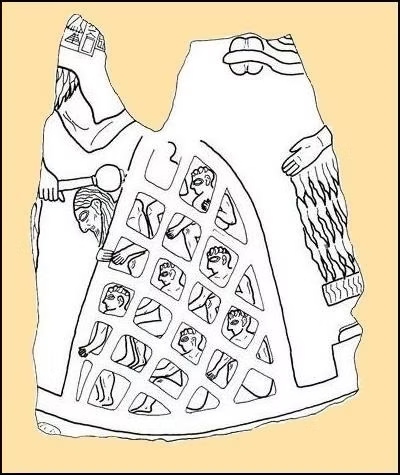
Sargon holds a net full of prisoners,
men he captured during the civil war.
Ur-Zababa struggles to escape from
the net. Sargon clubs him with a mace.
After Sargon defeated the Sumerian king Lugalzagesi, he paraded him through the streets
in a neck stock. Then he forced Lugalzagesi to watch the construction of a victory stele commemorating his own defeat. After the stele was completed, Lugalzagesi was executed. Then Sargon forced Lugalzagesi’s widow to marry him so he could unite Sumer and Akkad under a single dynasty.

Vultures and war dogs feed on the bodies of dead Sumerian soldiers.
Then Sargon sent Enheduanna to Sumer as a gesture of reconciliation.
Sargon shipped her off to this hostile foreign land to be the benign face of his military regime. The Sumerians were a proud people. They hated Sargon, positively hated him, because
he had taken away their freedom. By extension they hated Enheduanna too. Being an apologist for her father (like she had any other choice) did not endear Enheduanna to the Sumerians.
It’s doubtful that she had a single Sumerian friend. She probably socialized only with her Akkadian entourage, but even then she was isolated by being the daughter of the dictator.
She couldn’t be sure if anyone sincerely liked her, or if they were merely trying to curry favor
with her father.
The sacking of the temple
At some time after the death of Sargon, the Akkadian empire was teetering on the brink
of collapse. There were scattered rebellions everywhere. In Ur, one revolt was led by a man
named Lugal-Ane. He invaded and ransacked the temple of Nanna, killing the attendants before confronting Enheduanna. “He took the crown of the high priestess from me, giving me
a knife and dagger instead. ‘These suit you better,’ he said.” This was either a veiled threat or
an invitation to suicide. He demanded that Enheduanna recognize his authority. She refused, and was forced into exile. Lugal-Ane was eventually defeated by Sargon’s grandson Naram-Sin, who regained control over Ur. He restored Enheduanna to her position in the temple,
and she served for a short time before she died.
Enheduanna’s account of the events is given in “The Exaltation of Inanna,” which is her
best known literary work. She pleads with Nanna the moon god, and his daughter Inanna,
to avenge the crimes against her and to capture Lugal-Ane.
I suggest that Enheduanna’s statue was destroyed when Lugal-Ane ransacked her temple.
This statue lay shattered at her feet when she was being threatened by Lugal-Ane.
The broken statue is a testament to the bravery of Enheduanna. She refused to be intimidated.
She did not back down, even after her attendants had been murdered.
See the damaged statue of Enheduanna shown at its actual size.
The Face of Enheduanna
Enheduanna is the first author in the world who is known by name. She is also the first recognizable woman in all of human history. I think it a shame that her portrait was vandalized in her lifetime, more than 4,000 years ago. She is much too important to let this be the final image of her for all eternity.
I therefore decided to “restore” her photograph.
Now people can see the face of this truly remarkable woman.
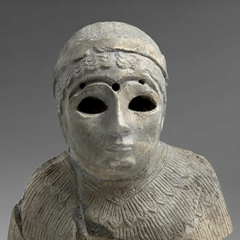

I included the star of Venus, the symbol of Inanna, and the moon, the symbol of Nanna.

In closing, who was Enheduanna?
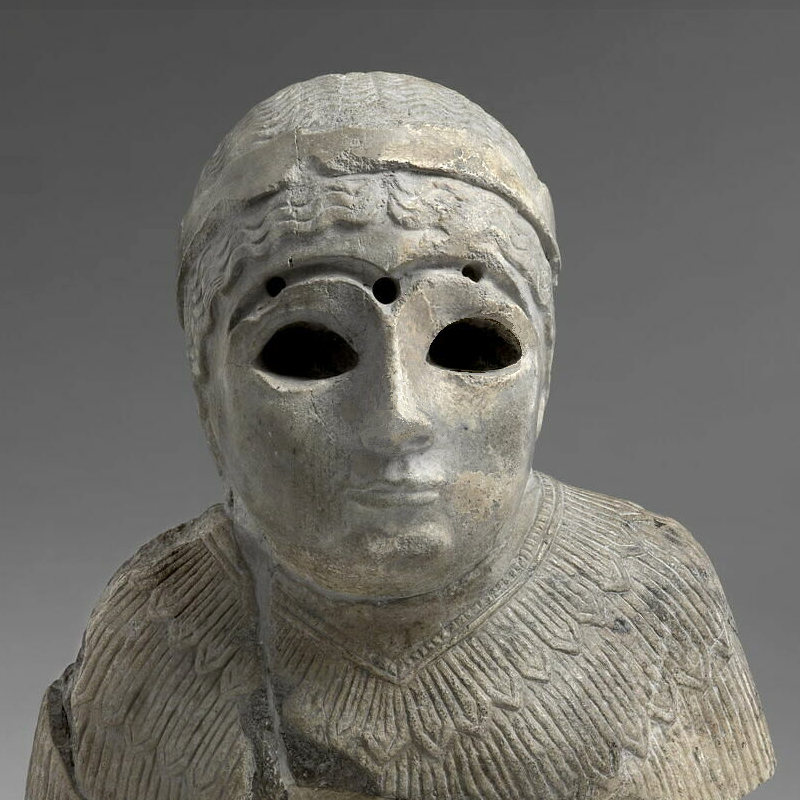
I think that beneath it all, Enheduanna was a lonely woman, cut off from any real companionship. I think the only time she felt truly content is when she was writing.
It was the only time when she could shut out the world, think her own thoughts,
and just be herself.
Her face is an enigma. Is she looking at you with clear-eyed intelligence, or is she
staring into middle distance, keeping her opinions private. You should decide
for yourself what you can see in her face.
To me, her face looks sad. Perhaps it’s because of the vacant eyes, or maybe it’s
because I think her life was not as fulfilling and glamorous as it is made out to be.
It was a stressful and demanding life, filled with onerous responsibilities. It was not
the life she chose, but the life that was forced upon her.
Yet she somehow persevered, and made herself famous – in her own right.
Now she is more famous than her father.
It is said that Enheduanna died young, when she was only 35 years old,
but now she lives forever.
Today, in the modern age, Enheduanna is a feminist icon. She certainly
deserves the proper recognition for her achievements, but let us not forget
the woman behind the myth.

January 9, 2026
